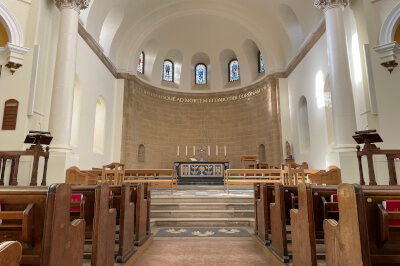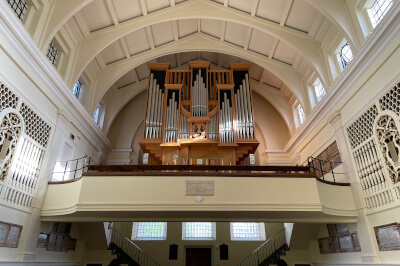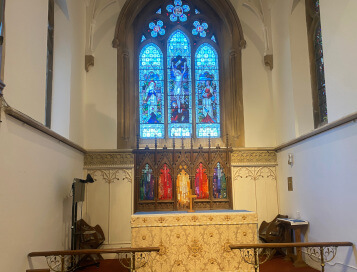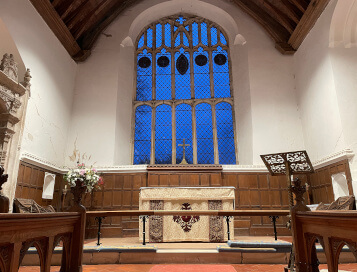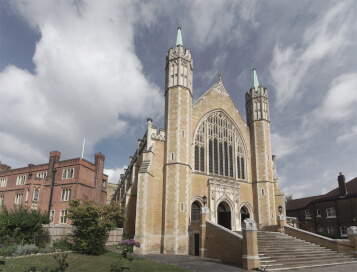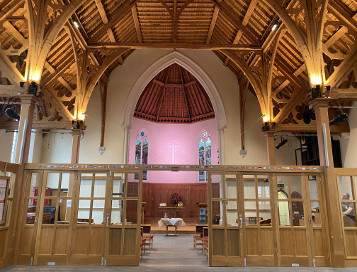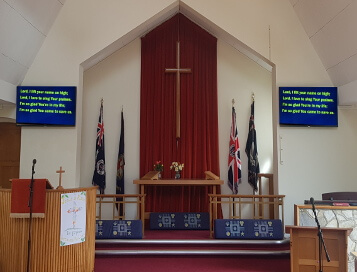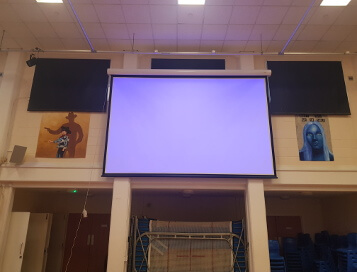

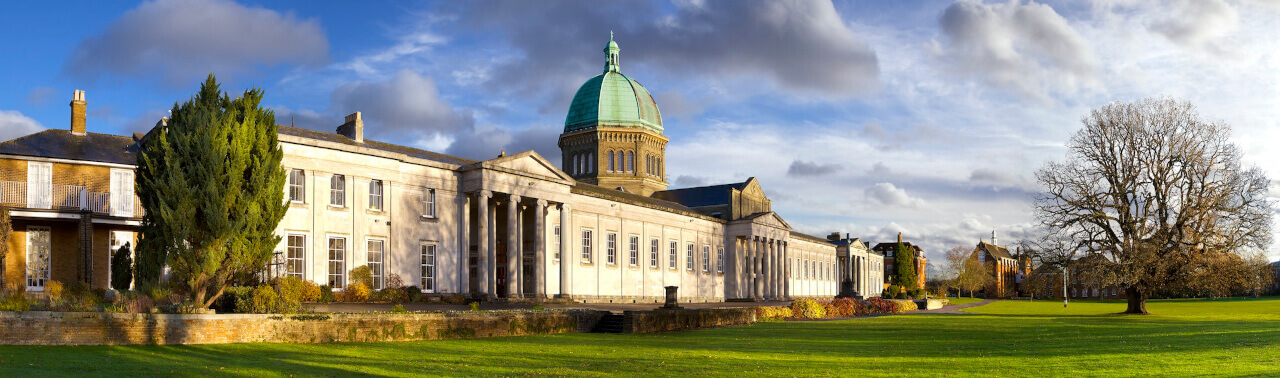
When the East India Company established its training college in 1809, the original central building of the Quad was used as a library. In 1862 architect Sir Arthur Blomfield was commissioned to adapt the buildings for a boarding school and repurpose the old library into a chapel. After a fire in the chapel caused extensive damage, it was rebuilt in 1876-78.
Haileybury approached Clarity in 2022 to begin discussions about upgrading the sound system in their Chapel. First an introductory design proposal was provided which made a good starting point for discussion with the school and their electrical contractors who would need to know where to install containment and power. There followed a lot of design tweaking and plans finally came to fruition in 2026.
The chapel’s challenging acoustics made it difficult to amplify services with high intelligibility, and the building aesthetics would not easily accommodate a distributed system. Beam steerable column speakers from industry leader Renkus Heinz, combined with smaller fill loudspeakers for the nooks and crannies were utilised as the perfect tool to solve the problem. Tests and demonstrations were undertaken and the way forward quickly settled.
Speech Intelligibility and Even Coverage
Renkus Heinz OCONYX column loudspeakers make use of digital beam-steering technology that allows sound to be highly controlled and focused over a predetermined listening area. By avoiding reflective surfaces, in this case the high ceiling and in particular the dome, reverberation levels can be controlled.
Beam-steering increases the forward energy of the loudspeaker to place listeners in the direct sound output field of the loudspeaker, rather than the reverberant field where sound is “distant”. This combination of reverberation reduction and placing listeners in the direct sound field massively improves speech intelligibility, which Clarity were able to demonstrate onsite to great effect.
Beam steering creates a tailored coverage pattern to hit a defined audience area. Extremely even front to back coverage can be achieved without the need for loudspeaker delays.Small speakers can be used to enhance coverage to specific areas not covered by the main beam, restoring high-frequency content to those areas in a very discreet manner.
Aesthetics
Column loudspeakers of this type naturally fit into architecturally impressive environments such as this Chapel. Their tall, thin nature is pleasing and allows for placement in narrow areas or next to other column-like structures. The discreet nature of these loudspeakers is improved further by colour matching them to the space and through careful installation methods.
A pair of Renkus Heinz ICC24/3-RD1 loudspeakers were wall-mounted either side of the chancel opening around 2.4 metres from the main seating area floor level.
The ICC24/3, part of Renkus-Heinz’s Iconyx Compact range, is a fully contained, self-powered enclosure measuring 2 metres in height, with 24 x 3” full-range loudspeaker drivers, each with their own amplification and DSP (digital signal processing) channel.
The directional beam provides for excellent control of mid-range and bass frequencies whilst providing coverage broadly across the listening area. High frequency (HF) coverage at 4kHz 3 octaves is within 3dB front to back.
A number of very discreet Outline Ai81s column loudspeaker, a passive unit requiring external amplification and containing 8 x 1.3” LF drivers with 1 x 0.7” HF driver, were chosen to provide fill for areas outside the coverage of the main PA. Supported by the ambient low frequency bloom, these little enclosures (only 46mm wide) provided the upper-mid and HF detail needed.
Microphones
In addition to some new Sennheiser EWD radio mic and new lectern gooseneck mics with Sennheiser ME34 capsules (already used in other areas of the school), the chapel required a complete new set of installed microphones to enable recording and streaming of various events that are held in the space. RODE NTG3 and DPA 6061 Omni Microdot microphones were installed at high level around the perimeter of the Chapel to pick up on ambient sound and to be focussed on the choir, organ and congregation. These microphones were fed into Yamaha Tio1608 digital stage boxes for onboarding to the DANTE™ network (more on this in a moment).
Control
The central hub of this system is the MRX7D Yamaha’s digital signal processor, a DSP which includes DANTE™ network control. Haileybury have standardised on the MRX7D for various areas of the school, all installed by Clarity SLV, and have a segregated VLAN on the school network hosting DANTE traffic. This provides huge flexibility by opening access to any local audio system from virtually anywhere in the school. This means they can record a chapel choir service from an office 500m away.
The MRX7D processor is an open architecture device (this means that signal flows can be built – virtually – by the system designer using drag and drop modules). It has a host of built-in tools such as parametric equaliser, four channel feedback reducer, system limiter, automatic microphone mixer and ambient noise compensation.
A further benefit of the system is that simple and intuitive wall controls can be used to quickly access the system. Ideal for day-to-day use without the need for a techy. An elegant Yamaha MCP1 control panel with an alpha-numeric display was used for this purpose.